An electric-fence line is a hybrid product. The polymer jacket carries the mechanical load and the UV exposure; the metal conductors carry the pulse from the energizer to the animal. A line with the polymer right and the conductors wrong is a poor fence, regardless of how good the polymer looks on the reel. This guide is written for the buyer who has to choose between quotations — and who needs to compare them on the fields that actually change performance.
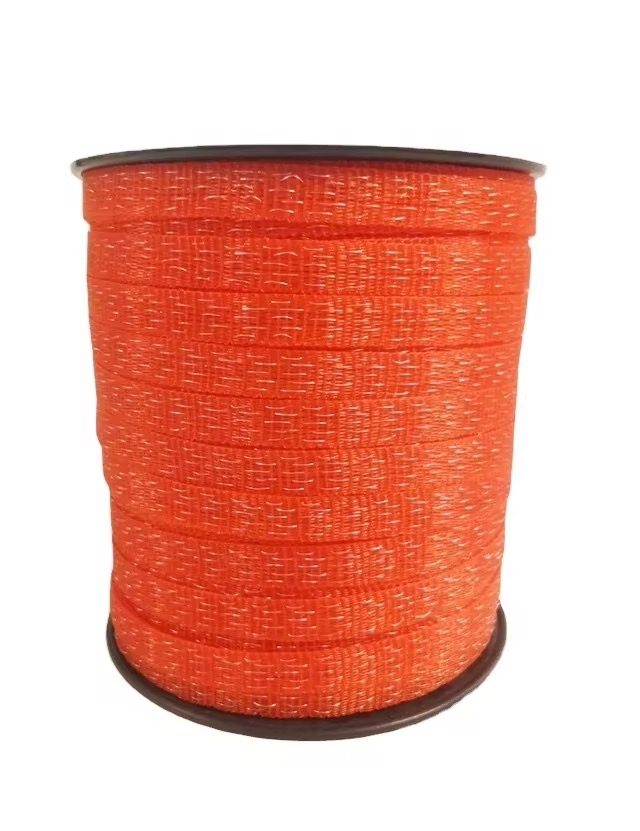
What the conductors are actually doing
An energizer sends a short, high-voltage pulse down the fence. The animal touches the line; the pulse flows through the animal to ground; the animal learns to stay back. The voltage at the far end of the fence must stay high enough for the animal to feel a meaningful shock. As the line gets longer, the resistance of the conductors causes the voltage to drop — and a long fence with too few conductors, or with the wrong conductor material, has a weak far end.
That is the single physical fact that drives every other field on the spec sheet. Everything else is a way of controlling voltage drop over distance.
Conductor material
Three families are in common use:
- Stainless steel — the most common choice for permanent and semi-permanent outdoor fences. Corrosion-resistant, moderate conductivity per mm, holds up under tension over multiple seasons.
- Tinned copper — higher conductivity per mm than stainless steel and more flexible, so the metal conforms to the braid. Less corrosion-resistant where the line meets damp soil, effluent or fertilizer; usually specified for shorter and portable systems.
- Aluminium and aluminium alloys — used in some lightweight constructions. Lighter than copper, less expensive, but more sensitive to mechanical damage at joints and splices.
For most pasture fence applications the practical difference between stainless steel and tinned copper is small. The construction — how even the metal contact is along the length — is set by the production line, not the metal. What you compare in the RFQ is the conductor material and diameter on the offer, not a generic metal name.
Conductor count and diameter
The two numbers that change resistance the most are how many conductors are in the line and what diameter each one is. Resistance of a metal conductor scales inversely with cross-sectional area and directly with length, so doubling the number of conductors roughly halves the resistance per metre for the same conductor diameter.
- Polywire commonly runs 3 to 6 conductors of around 0.16 mm.
- Polyrope commonly runs 6 to 9 conductors in the 0.20 – 0.30 mm range.
- Polytape varies widely — 4 to 9 conductors is typical, with thinner diameters than polyrope.
More and thicker = lower resistance = better long-line performance. The trap is comparing two lines only on count (two 6-strand polyropes can have very different resistance depending on the metal and the braid). Always ask for the resistance number too.
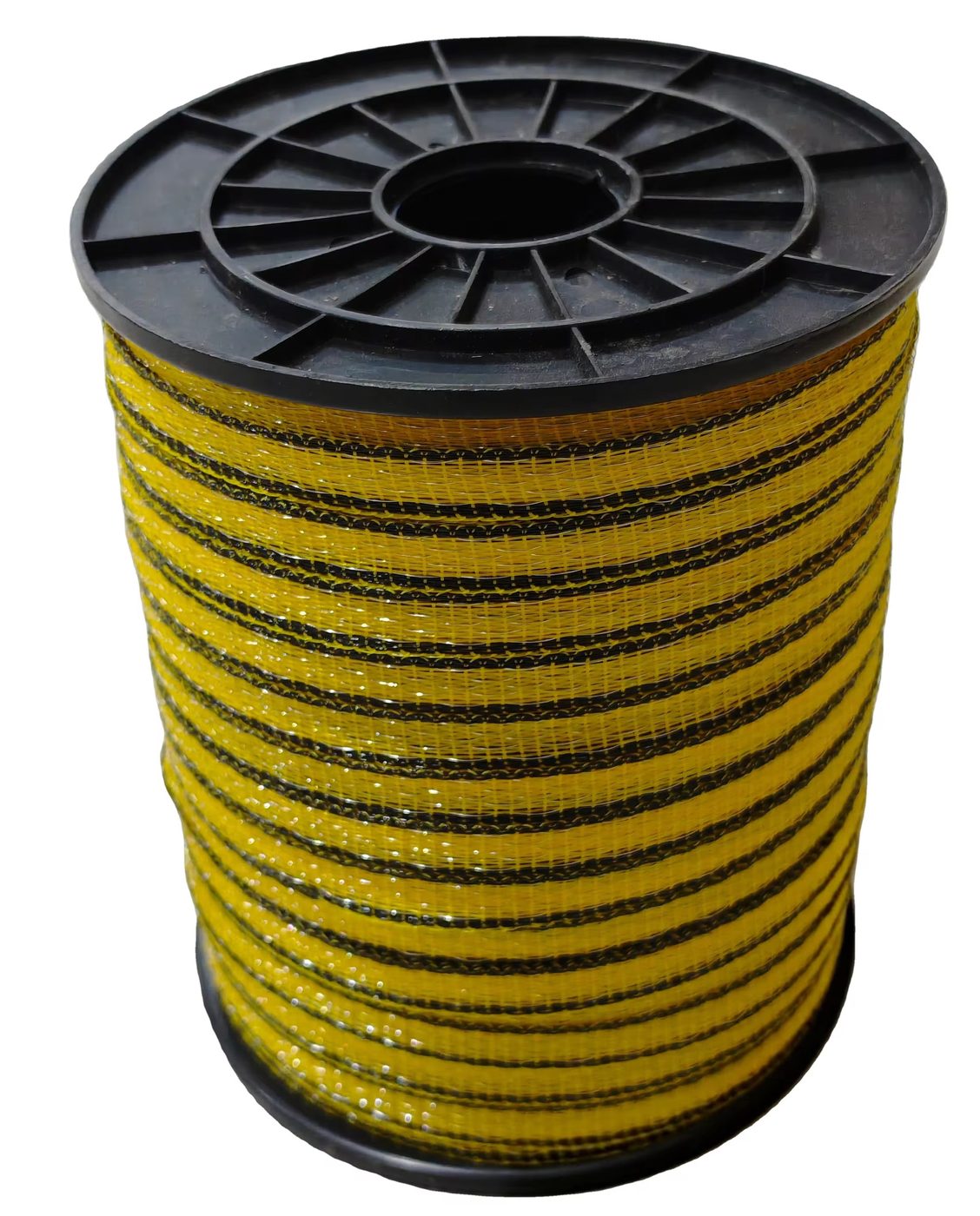
Resistance in Ω/m — the single most useful number
If only one field is on the quotation, this should be it. Resistance is reported in ohms per metre (Ω/m); lower is better. The relationship between resistance and fence performance is mechanical, not marketing:
- The energizer outputs a fixed pulse.
- The voltage that arrives at the far end of the fence equals energizer voltage minus the voltage drop across the line.
- The voltage drop across the line is (current × resistance × length). Doubling the fence length roughly doubles the drop.
So a line with half the Ω/m runs roughly twice as far for the same far-end voltage, all else equal. For permanent multi-strand fences this matters; for short portable fences it usually does not.
There is no universal “good” number — the right Ω/m depends on fence length, animal and energizer. But for a multi-strand permanent fence, single-digit Ω/m on the polyrope or polytape is the practical range; multi-Ω/m polywire belongs on portable fences. The supplier should be able to advise on conductor count for the specific fence length and energizer — that is part of what you are paying for.
Polywire vs polyrope vs polytape — selection logic
| Format | Best fit | Trade-off |
|---|---|---|
| Polywire | Short portable fences, rotational grazing, temporary subdivision | Cheapest, lightest, lowest wind load, lowest visibility |
| Polyrope | Semi-permanent horse and cattle fences, longer runs, multi-strand permanent | More conductors and more mechanical strength than polywire; more visible |
| Polytape | Horse fences, short runs where visibility is the priority | Most visible, highest wind load, widest range of conductor layouts |
The format choice is driven by the fence, not by the supplier’s catalogue. A common mistake is to specify polytape on a windy exposed site — the wind load flogs the tape and shortens service life. Another is to specify polywire on a permanent horse fence where visibility matters and a heavier line is appropriate.
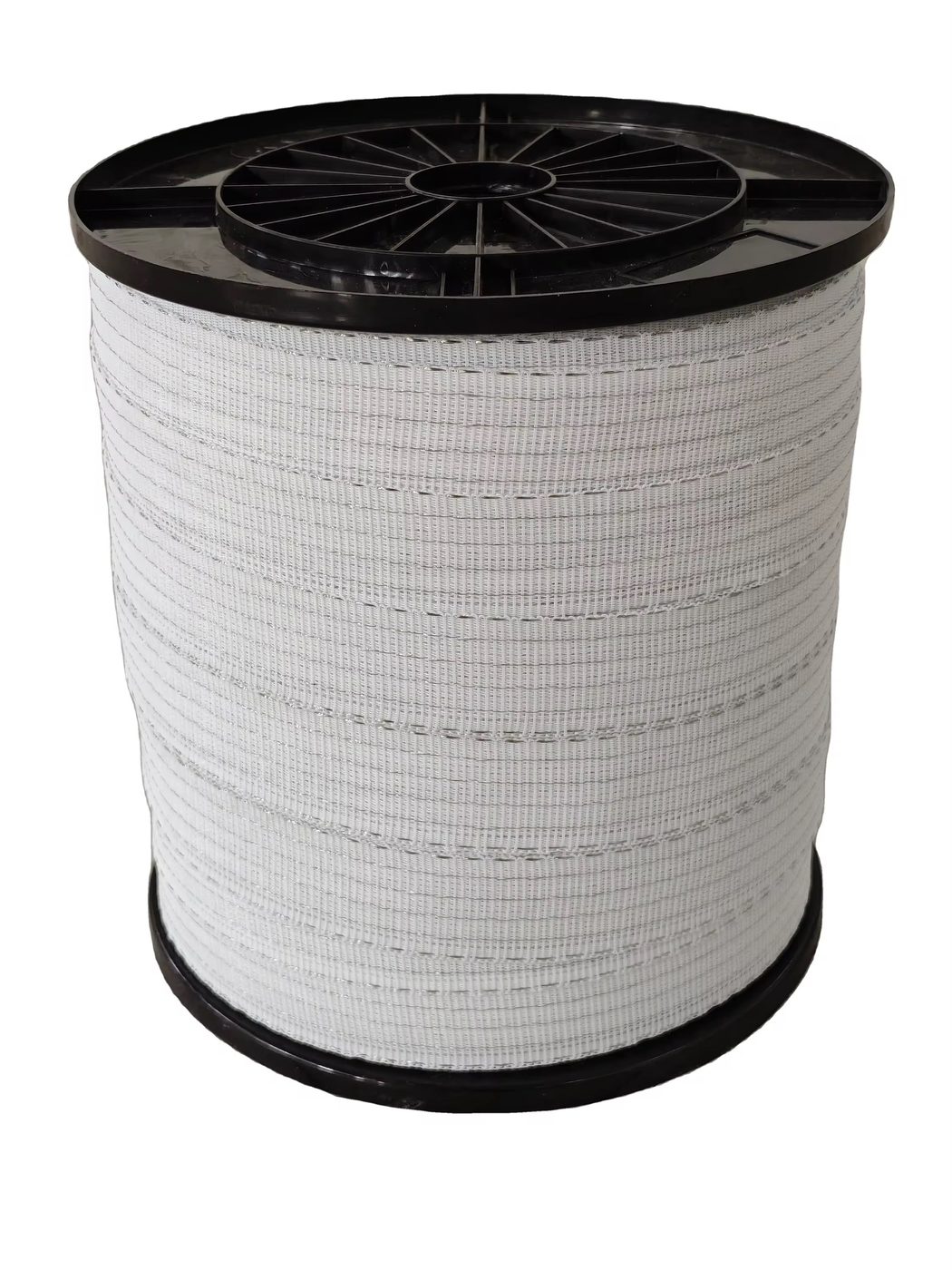
UV stabilization
Sunlight’s UV radiation breaks down polymer chains over time; the rope looks intact until it snaps. UV performance is a property of the polymer jacket, not of the conductors. Specify UV-stabilized material for any line that will see more than one season outdoors, and confirm against the intended service life in the RFQ.
Carbon-black pigment improves UV resistance versus natural or unpigmented polymer, but it is not a substitute for proper UV stabilization. Specify both colour and UV package in the quotation — a “black” rope is not automatically UV-stabilized.
Reel length and winding
Reel length is more than a packaging choice:
- Container math. A 250 m reel and a 500 m reel of the same line take different container volumes. For larger orders, the reel length and the reel dimensions matter for freight.
- Winding tension. A poorly wound reel that has been tensioned unevenly will unwind with kinks and twists in the field; that is hard to spot on the supplier’s photo but obvious on a physical sample.
- Reel format for retail. If the line is sold into retail or farm-store channels, the reel has to be sized for the shelf or the twine-box the customer uses. A bulky industrial reel is wrong for a 250 m retail SKU.
A consistent reel length across a quotation makes freight and pallet planning straightforward. State the preferred reel length and the maximum acceptable variation.
How many reels does a fence need?
Buyers often quote “some reels” and then discover the order is short, or that a 500 m reel is unworkable for a temporary strip. A usable estimate only needs three numbers:
- Perimeter or run length you intend to fence (metres).
- Number of electrified strands (1–5 is common on livestock fences; more strands = more line).
- Reel length you are buying (200 m / 250 m / 500 m — state it in the RFQ).
line needed (m) ≈ fence length × strands × (1 + 10% joint / waste allowance)
reels ≈ ceil(line needed ÷ reel length)
Example (illustrative only): a 400 m three-strand horse fence needs about 400 × 3 × 1.1 ≈ 1,320 m. At 500 m per reel that is three reels; at 250 m per reel it is six. Temporary single-strand strip grazing needs far less — and usually a lighter polywire rather than polyrope.
Always confirm strand count and gates/corners with the person who will tension the fence. Reel count is an ordering aid, not a fence design.
Connector compatibility
The conductors need to make reliable contact at every join, splice, gate handle and corner. Two things to specify in the RFQ:
- The connector system used on the existing fence — whether it is a knotted join, a spliced eye, a gate handle with a specific contact, or a compression connector. The new line has to make reliable contact with the existing hardware.
- Any specific joiner / gate-handle reference the buyer has standardized on. A line that performs well electrically but does not fit the buyer’s hardware is still a miss.
Breaking load — read it carefully
Breaking load is the mechanical strength of the polymer jacket, not the fence’s electrical performance. For permanent fences and high-tension situations it matters — the line has to survive tensioning, stock pressure and weather without breaking. For short portable fences it usually does not.
Two cautions:
- A higher breaking load figure on a quotation does not automatically mean a better fence. It usually means a heavier, more expensive jacket. Match the breaking load to the fence duty, not to a wish-list number.
- Factory-reported breaking loads are typically from internal tensile testing on the producer’s equipment. They are useful for batch-to-batch comparison; they are not equivalent to an independent laboratory tensile report. If the application requires an independently witnessed tensile figure, that has to be requested and costed separately.
Factory self-test vs independent third-party test
A factory self-test on electric-fence line covers the fields a production line can run quickly and repeatedly — continuity, conductor count, basic resistance, basic tensile, reel length and winding condition. It is run on the producer’s own equipment against the producer’s own reference methods. A self-test is useful for batch-to-batch comparison across one supplier; it is useful as a sanity check when goods arrive.
An independent third-party test is run by a laboratory that has no commercial relationship with the producer. It carries its own report, its own identification numbers and is reproducible by the buyer’s own lab. If a buyer requires a third-party report — for a regulated tender, a controlled retailer, or an export programme — that has to be requested and costed as a separate item. It is not included by default, and quoting one in place of the other is a routine source of disagreement.
The distinction matters because the same line can pass a factory self-test and still fail an independent laboratory test, or vice versa. The right test is the one that matches the buyer’s downstream requirement.
Specification checklist for the RFQ
For a comparable quotation, the RFQ should include at least:
- Format — polywire, polyrope or polytape.
- Conductor material and diameter — stainless steel / tinned copper / other; diameter in mm.
- Conductor count — number of conductors in the construction.
- Resistance target in Ω/m — at least a maximum value the buyer will accept.
- Tape width or nominal diameter — for polytape, tape width; for polywire / polyrope, nominal rope diameter.
- Colour and pattern — for polytape, the colour combination; for polyrope, the rope colour.
- UV package — confirmed against the intended service life.
- Reel length and reel type — preferred reel length, acceptable variation, reel type.
- Total quantity — in reels, metres or both.
- Fence length and animal — so the supplier can sanity-check the conductor specification.
- Connector / hardware reference — any existing joiner or gate-handle the line must match.
- Packaging and label — shrink-wrap, retail label, barcode, master carton, shipping mark.
- Test requirement — factory self-test only, or third-party lab report needed.
- Destination country — for freight terms and any export documentation.
If a downstream customer or tender also names a compliance document (declaration, third-party report, audit), say so in the first message — see rope compliance, testing and import docs.
The structured RFQ form walks through exactly these fields. The current electric-fence product range — polyrope and polytape — sits inside the broader electric fence rope application page.